State DOT
Capital programs, design coordination, contractor delivery, inspection evidence, and closeout oversight stay linked across agencies and delivery partners.
We use essential cookies to run the site and optional cookies to improve your experience and measure usage. You can change your choice anytime in Cookie Preferences.
CONSTRUCTION INDUSTRY ECOSYSTEM · OWNERS & AGENCIES
Public owners, private owners, developers, transportation agencies, utilities, universities, healthcare systems, corporate real estate, military, and municipalities share one governed view of delivery partners.
Clearer portfolio oversight and audit-ready evidence across contractors and phases.
Construction Industry Intelligence
Owners and agencies set capital intent, funding, and governance. Ezelogs connects that intent to estimating, construction operations, commercial status, inspections, and asset handoff — without replacing agency systems of record.
Built for Owners, owner’s reps, agencies, developers, and capital program offices.
Who this includes
Product proof
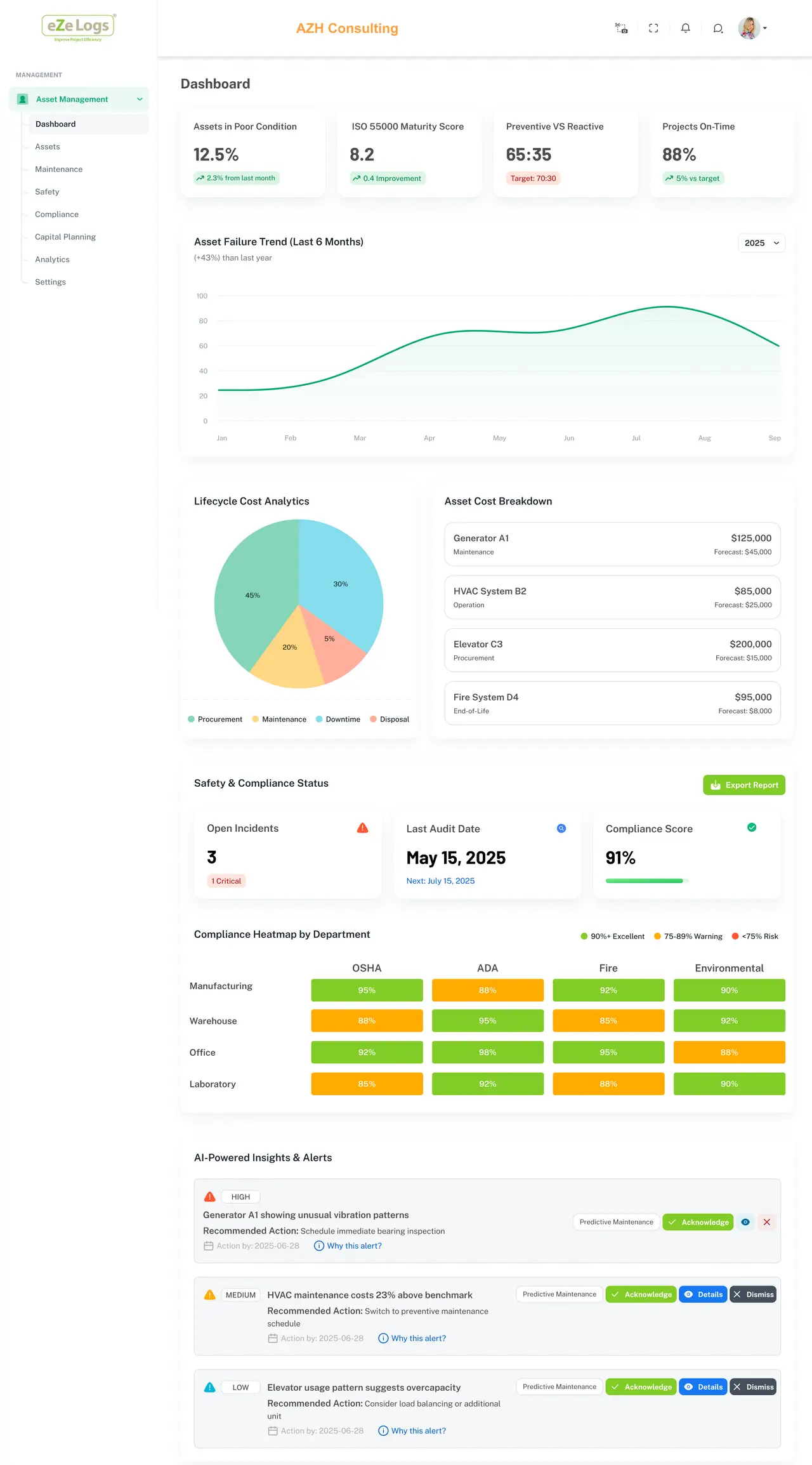
Capital and delivery status roll up for review.
Industry lifecycle
One reusable lifecycle from market need through lessons learned. Highlighted stages show where this stakeholder contributes.
AI ASSISTANCE — ADVISORY
Recommendations surface with evidence. Approvals stay human-governed. No autonomous contracting, inspection closure, or payment actions.
Inputs
Outputs
Connections
Pre-Construction → Construction Operations → Commercial Operations → Executive · Portfolio · Owner · Benchmarking · CIOS · Construction Industry Intelligence
Journey examples
Capital programs, design coordination, contractor delivery, inspection evidence, and closeout oversight stay linked across agencies and delivery partners.
Campus capital projects connect planning, design review, construction administration, and facilities handoff on one governed lifecycle.
Program governance, compliance evidence, inspection coordination, and contractor reporting stay audit-ready across delivery partners.
Business outcomes
Status claims stay linked to field and commercial evidence.
Designers, GCs, trades, and inspectors share one narrative.
Commissioning and warranty transition stay connected.
Evidence & governance
Consequential actions stay with accountable people and role-based controls.
Canonical RFI and Daily Field records remain on the work they support. Ezelogs does not introduce a second write authority.
Keyboard-operable surfaces, clear focus, and readable contrast across the public website.
Public pages stay available while investor-private materials remain access-controlled.
FAQ
No. Ezelogs is Construction Industry Intelligence for the full ecosystem — owners, agencies, designers, GCs, specialty trades, suppliers, workforce, inspectors, and asset operators.
No. Pre-Construction, Construction Operations, and Commercial Operations remain the authoritative operational families. The ecosystem experience explains how participants connect across them.
No. AI assistance is advisory. Documents, signals, and recommendations support human approvals — consequential actions stay with accountable people.
Related products & resources
Walk how owners, designers, contractors, suppliers, workforce, inspectors, and operators share one Construction Industry Intelligence layer.