Governed visibility
Assignment and compliance status stay on one record instead of a spreadsheet.
We use essential cookies to run the site and optional cookies to improve your experience and measure usage. You can change your choice anytime in Cookie Preferences.
CONSTRUCTION OPERATIONS INTELLIGENCE · EQUIPMENT & ASSETS
Track equipment and asset assignment, condition notes, and compliance status on one record connected to field execution and job costing — advisory visibility, human decisions.
Governed equipment visibility connected to field execution and job costing — decisions stay human.
Product overview
Equipment & Asset Management extends Construction Operations Intelligence into the resources that make execution possible. Assignment, condition, and compliance status stay attached to the same operating record as field activity and cost — without telematics, GPS tracking, or predictive maintenance claims.
Built for Equipment managers, superintendents, and cost engineers.
Product proof
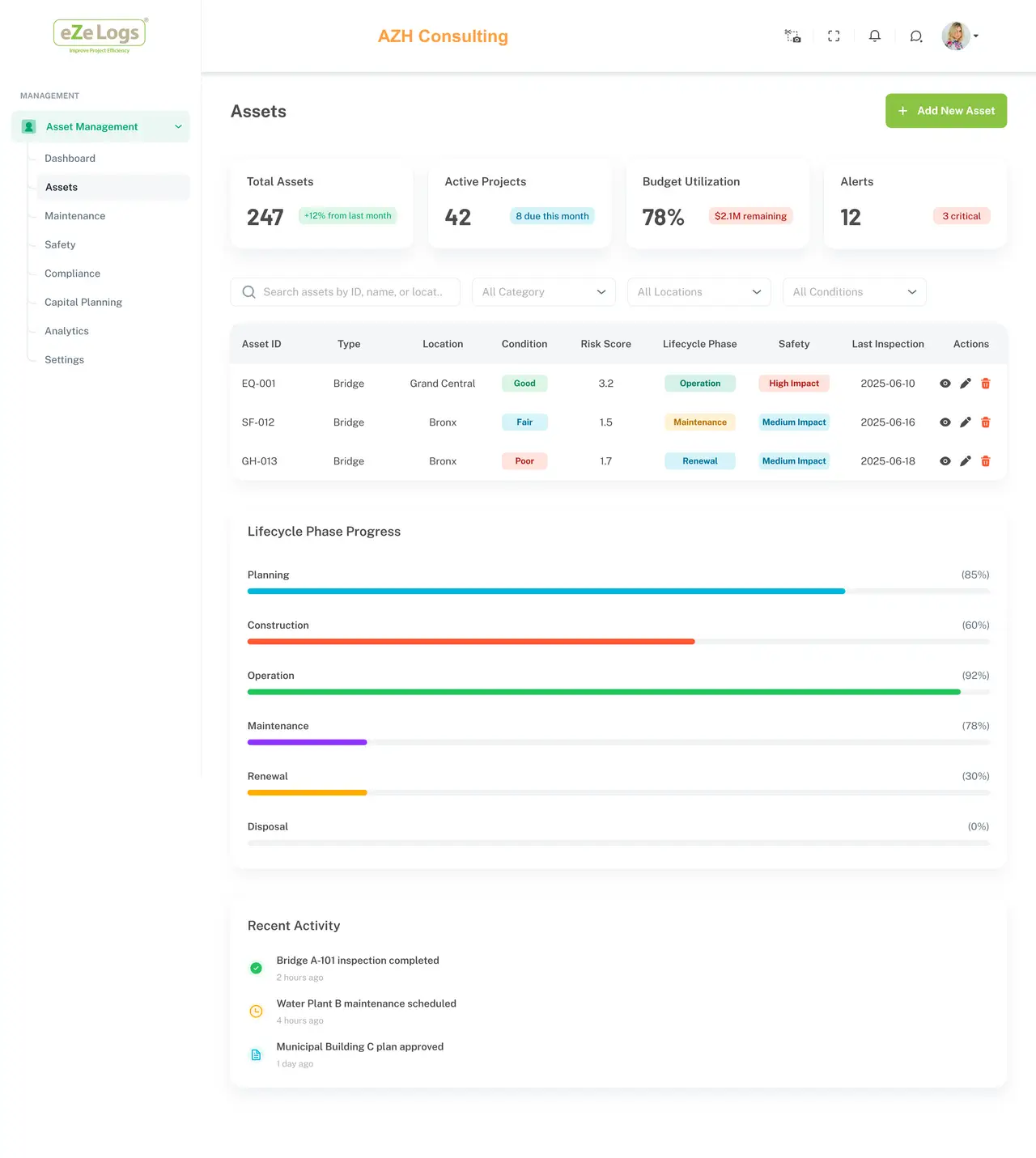
Assignment, condition notes, and compliance status stay together instead of a separate spreadsheet.
End-to-end workflow
One continuous family — current stage highlighted, full path visible.
Lifecycle position
Who uses this module
Track assignment, condition notes, and compliance status across the fleet on one record.
ExploreConfirm equipment availability against the daily plan before crews rely on it.
ExploreSee equipment assignment alongside job costing for accurate cost allocation.
ExploreAI ASSISTANCE — ADVISORY
Assistance is advisory visibility only. Ezelogs does not use telematics or GPS tracking, does not predict maintenance needs, and does not reassign equipment automatically.
Inputs
Outputs
Connected modules
Field Management → Daily Reports → Safety → Quality → Photos & Media → Equipment & Assets → Job Costing → Executive Experience
Business outcomes
Assignment and compliance status stay on one record instead of a spreadsheet.
Advisory flags surface overlapping requests before they reach the field.
Assignment history supports accurate job costing without manual reconciliation.
Construction examples
An overlapping assignment request between two projects is flagged for the equipment manager to resolve.
An upcoming certification date is flagged for manual scheduling before the equipment goes back into rotation.
A logged condition note surfaces for review before equipment is reassigned to a new crew.
Evidence & governance
Consequential actions stay with accountable people and role-based controls.
Canonical RFI and Daily Field records remain on the work they support. Ezelogs does not introduce a second write authority.
Keyboard-operable surfaces, clear focus, and readable contrast across the public website.
Public pages stay available while investor-private materials remain access-controlled.
FAQ
No. Equipment status is based on manually logged assignment, condition, and compliance records — not location tracking or telematics feeds.
No. Ezelogs does not offer predictive maintenance. Condition notes and compliance dates are visibility aids for manual review.
Assignment records provide context job costing can reference for cost allocation — cost entries themselves remain a controls decision.
Related products & resources
Walk Field Management → Daily Reports → Safety → Quality → Equipment as one governed suite.